
SCBA cylinder hydrostatic testing in Malaysia, on a water jacket bench
Breathing apparatus cylinders tested in a Galiso water jacket tester.
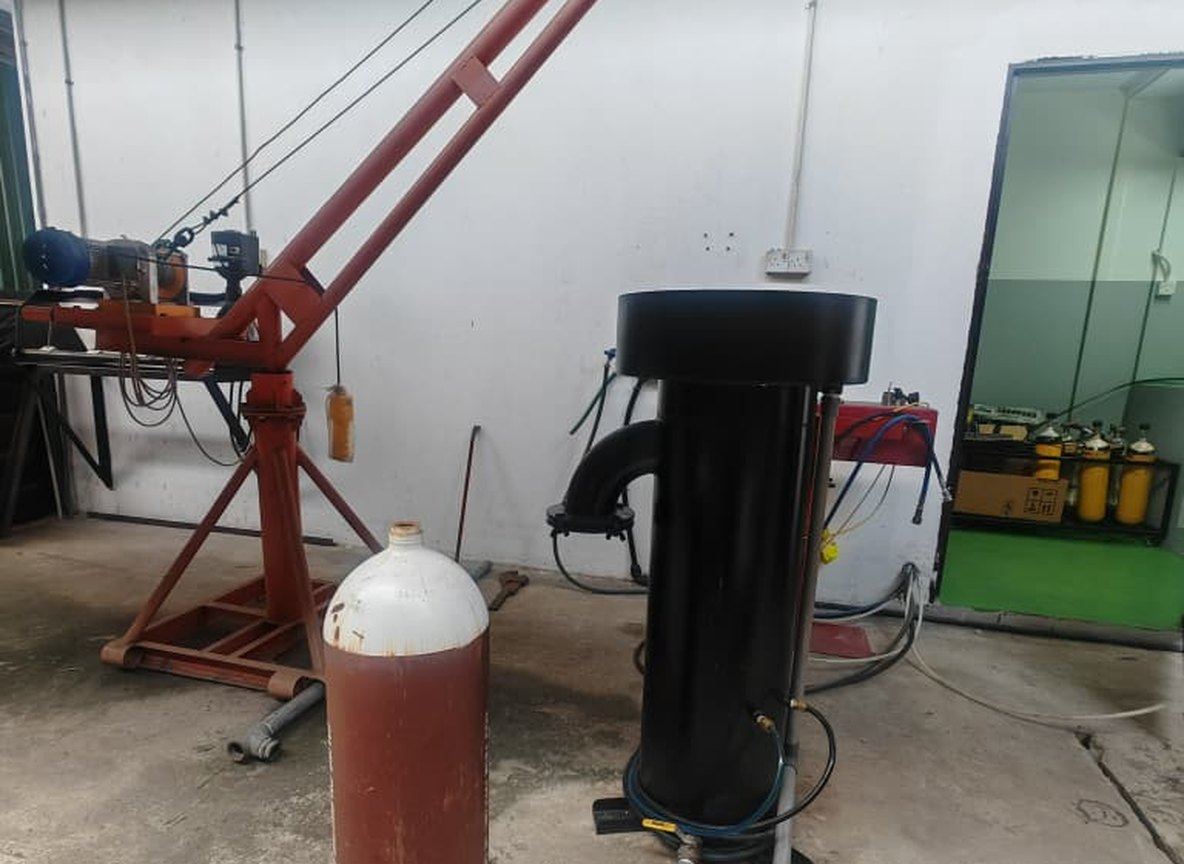
TopBorneo tests breathing apparatus cylinders on a Galiso water jacket tester in its workshop.
The test puts the cylinder under pressure and measures how far it stretches and whether it returns to its own size. A cylinder that stays stretched has lost strength and comes out of service.
Cylinders tested under water in a jacket
Why work with TopBorneo
Tell us the job, the site and the crew. We work out what fits instead of sending a catalogue back.
MSA, KStrong and Bullard straight from an official distributor, with lighter lines alongside them.
Gas detectors, breathing apparatus and cylinders are serviced by our own technicians.
The same people handle your enquiry, your order and your servicing.
Read more
Open a section to read the detail behind it.
What a water jacket test measures
The water jacket test is the standard method for high pressure cylinders, and it is easier to follow than the name suggests.
| Step | What happens |
|---|---|
| 1 | The cylinder is filled with water and placed in a closed jacket that is also filled with water |
| 2 | The cylinder is brought up to test pressure. It swells, and pushes water out of the jacket |
| 3 | The water pushed out is measured. That is the total expansion |
| 4 | The pressure is released. The cylinder shrinks back and draws water in again |
| 5 | Whatever expansion does not come back is permanent expansion, and that is the number that decides pass or fail |
An everyday comparison: a rubber band that springs back is fine, and one that stays stretched is finished. The jacket full of water is simply the most accurate way to see the difference, because water does not compress.
The cylinder is also examined inside and out before it goes on the bench. Corrosion, dents and damage around the neck thread reject a cylinder on their own, without any pressure being applied.
How often, and where the five year figure comes from
Search for this and you will read "every five years" everywhere. That interval comes from the United States Department of Transportation rules, and it does not automatically apply to a cylinder in service in Malaysia.
What does decide your interval:
- The cylinder manufacturer's instructions for that specific cylinder. Steel, aluminium and composite cylinders are not treated the same, and composite cylinders also have a fixed service life after which no test can extend them.
- The dates stamped into the cylinder shoulder. Those show when it was made and when it was last tested.
- Your own procedure and your client's contract, which on oil, gas and marine sites is often the strictest of the three.
Send TopBorneo a photograph of the cylinder shoulder with the enquiry. The stamped markings say more about what your cylinder needs than any interval copied from a website.
Testing a cylinder is not servicing the breathing set
These are two separate jobs on two separate benches. The cylinder test says whether the pressure vessel is sound. It says nothing about the demand valve, the mask or the carrier. For those, see breathing apparatus servicing, and for the sets and cylinders themselves see breathing apparatus. TopBorneo confirms with the quotation what comes back with each cylinder. What the different kinds of paperwork mean is set out on the calibration certificates page.
What TopBorneo needs to know
- The maker and model of the cylinder, and whether it is steel, aluminium or composite.
- The water capacity and the working pressure, both stamped on the shoulder.
- The date of manufacture and the date of the last test, from the same stamping.
- How many cylinders, and whether the breathing sets are sent in with them.
With those four points TopBorneo can say what each cylinder needs before it is transported anywhere. Cylinders are heavy, and a wasted trip is expensive.
Where to send your equipment
Drop your equipment at either address, or ask us to collect it.
| Location | Address | Phone |
|---|---|---|
| Kota Kinabalu | Lot No 8, Lean Seng Industrial, Jln Undan, 88450 Kota Kinabalu, Sabah | 088-422 259 |
| Labuan office | Unit No. 3A-3, Level 3A, Labuan Times Square, Jln Merdeka, Bandar Labuan, 87000 W.P, Labuan Federal Territory | 087-462 259 |
Common questions
How often do SCBA cylinders need to be hydrostatically tested?
The interval comes from the cylinder manufacturer's instructions and from the dates stamped into the cylinder, not from a single rule that covers every cylinder in Malaysia. The five year figure seen on most websites comes from United States transport rules. Send TopBorneo the stamped markings and you get the answer for your own cylinders.
How is hydrostatic testing performed on SCBA bottles?
The cylinder is filled with water and placed in a sealed jacket of water, then brought up to test pressure. The water it displaces is measured, the pressure is released, and the expansion that does not come back is the permanent expansion. TopBorneo does this on a Galiso water jacket tester in Kota Kinabalu.
What makes a cylinder fail the test?
Too much permanent expansion is the main reason: the cylinder no longer returns to its own size, so it has lost strength. A cylinder is also rejected for corrosion, dents, heat damage or damage to the neck thread, and those are found by examination before any pressure is applied.
Where can SCBA cylinders be tested in Malaysia?
TopBorneo tests cylinders in its own workshop, so cylinders stay in Sabah and Labuan for the work. Send the stamped details first, because that determines what each cylinder needs.
Send your cylinder details
Email crm@topborneo.com with the maker, capacity, working pressure and stamped dates of your cylinders, or a clear photograph of the shoulder. WhatsApp works too: +60 10 959 0259 for Labuan, +60 16 775 0259 for Kota Kinabalu. TopBorneo replies with what each cylinder needs and what it costs.