
Confined space entry requirements in Malaysia
What the Malaysian code asks before anyone enters a tank, vessel or pit, and the equipment and certificate that go with it.
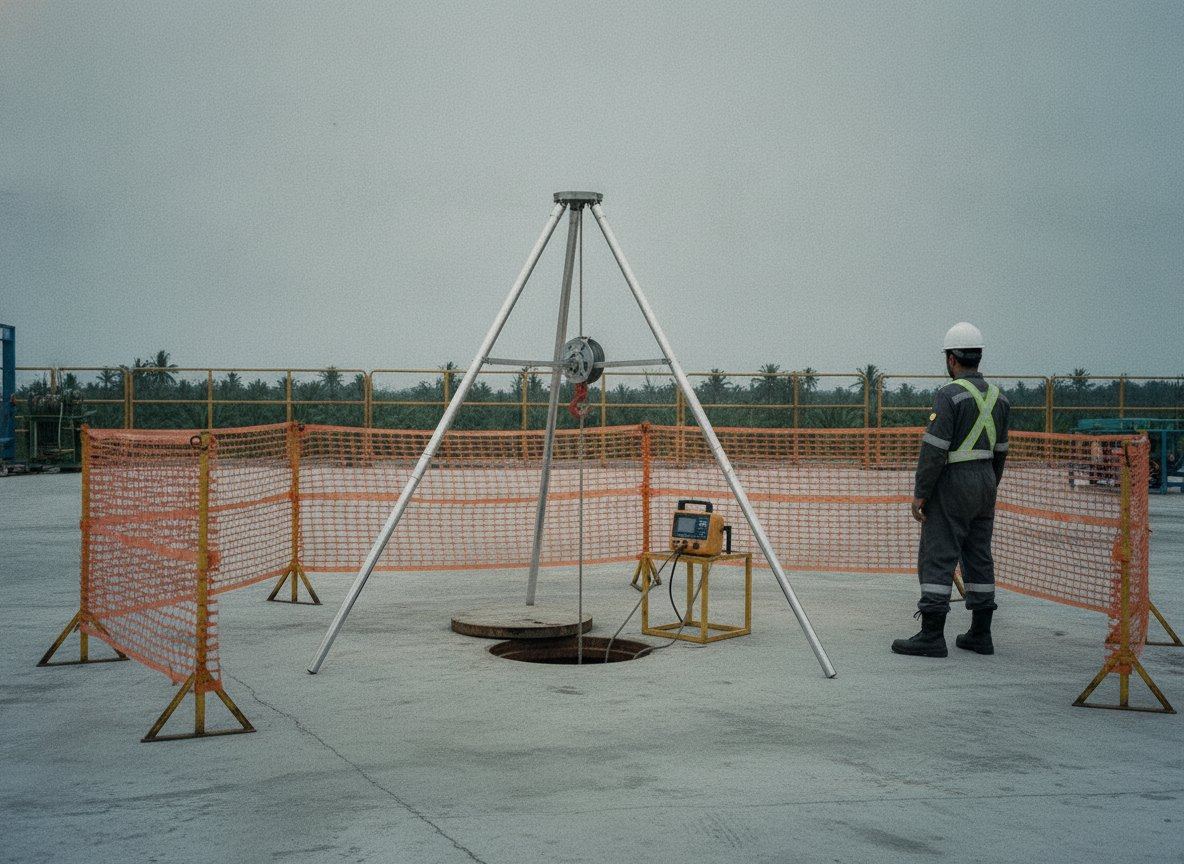
Malaysia's Industry Code of Practice for Safe Working in a Confined Space 2010 sets the rules for entry.
It asks for a permit to work of at most eight hours, an Authorised Gas Tester who takes the readings, and a detector calibrated the way its maker says. TopBorneo supplies, rents and calibrates that equipment across Malaysia.
The numbers the code sets
Why work with TopBorneo
Tell us the job, the site and the crew. We work out what fits instead of sending a catalogue back.
MSA, KStrong and Bullard straight from an official distributor, with lighter lines alongside them.
Gas detectors, breathing apparatus and cylinders are serviced by our own technicians.
The same people handle your enquiry, your order and your servicing.
Read more
Open a section to read the detail behind it.
What counts as a confined space
The code gives a definition rather than a list, because the same tank can be a confined space on Monday and not on Tuesday. This is the definition in paragraph 2 of the code, in plain words.
| The code says | What that means on site |
|---|---|
| An enclosed or partially enclosed space at normal air pressure, not designed primarily as a place of work | It is somewhere you go into to do a job, not somewhere you work every day |
| Which can hold harmful levels of contaminants at any time, or too little or too much oxygen, or which can cause engulfment | The air can turn bad, or loose material can bury a person |
| Could have restricted means for entry and exit | Getting out in a hurry is hard |
| A person whose head or upper body is inside has entered | Leaning in through the hatch already counts as entry |
The code names storage tanks, tankers, boilers, silos, pits, degreasers, pipes, sewers, tunnels, shafts and ducts. It also names shipboard spaces reached through a small manhole, including cargo tanks, ballast tanks and double bottom tanks.
The readings that decide whether entry is allowed
The code has a name for air that is not safe to work in: a hazardous atmosphere. Paragraph 2 lists four causes of one, and these are the numbers your gas detector has to be able to show.
| Reading | Limit in the code |
|---|---|
| Oxygen | Below 19.5 per cent or above 23.5 per cent by volume at sea level is a hazardous atmosphere |
| Flammable or explosive gas | More than 10 per cent of its lower explosive limit is a hazardous atmosphere |
| Toxic gas | At or above its permissible exposure limit is a hazardous atmosphere |
| Anything else immediately dangerous to life or health | Treated the same way |
Section 9 of the code turns those numbers into two rules. A confined space shall not be entered if the explosimeter reading is equal to or greater than 10 per cent of the lower explosive limit. Hot work must not be undertaken if that reading exceeds 1 per cent. Hot work is defined in paragraph 2 of the code, and it covers welding, cutting, grinding, drilling, blasting and heating.
The lower explosive limit is the lowest concentration of a gas in air that will catch fire. Ten per cent of it is a deliberate margin, well below the point of danger, and 1 per cent is a trace. Read that 1 per cent as the highest figure the code permits, not as a target. Your own hot work permit may set a lower limit, down to zero, and where it does, that lower figure is the one your crew works to.
The order of testing is fixed as well: first oxygen, then flammable gases and vapours, and last toxic gases and vapours.
How the reading is taken from outside the space
Paragraph 8.6.1.1 d says the atmosphere is tested from outside the confined space before any entry happens, and that the results go on the permit. Paragraph 8.6.1.1 e allows the more remote parts inside to be tested once the area next to the opening has been made safe. Both of those readings need a detector with a pump, a sampling line long enough to reach, and a probe on the end. A detector that only reads the air around its own case cannot take either one.
Three practical points come with that, and the first two are from the maker's manual rather than from the code.
- Wait before you read. MSA asks for a minimum of three seconds per metre of sampling line, one second per foot, so the sample reaches the sensors. On a five metre line that is fifteen seconds of drawing before the display means anything.
- Stay inside the length the line is rated for. MSA limits its 1.57 mm sampling line to fifteen metres, and the probe on the end must never touch a liquid surface.
- Switch the fan off first. Appendix F of the code recommends turning forced air ventilation off after purging, for long enough for a normal atmosphere to return, so you read the space and not the fan.
Say in your enquiry whether the unit has to be pumped and how far the line has to reach. That is the difference between two detectors that look the same in a catalogue.
Who is allowed to take the readings
The code requires an Authorised Gas Tester and Entry Supervisor, usually shortened to AGTES. That is a person appointed by the employer who has attended the confined space course for gas testers and entry supervisors and passed the examination. The gas tester identifies the chemical hazards, knows the entry equipment, and tests and interprets the readings. The entry supervisor checks that everything on the permit has actually been done. The person who issues the permit cannot be the same person who supervises that entry.
What TopBorneo supplies is the equipment that person works with, and the calibration certificate that shows the detector was in order.
The stand-by person outside the opening
The code names a second role, and that one never goes in. A stand-by person is appointed by the employer, stays outside the space for the whole of the entry, and has passed the course and examination for authorised entrants and stand-by persons. Paragraph 4.2.4 asks for at least one of them, for the duration of entry operations.
Paragraph 20 sets out the duties, and every duty needs something in his hands.
| What paragraph 20 asks of him | What that takes, outside the space |
|---|---|
| Keep an accurate count of who is inside and match it to the permit | The permit itself, posted at the entry portal |
| Communicate with the entrants regularly, and order an evacuation when he has to | Radios or another agreed means, which paragraph 6.2 k puts on the permit |
| Order everyone out as soon as any alarm sounds | Being able to hear the detector that is monitoring inside |
| Carry out non-entry rescue as the rescue procedure sets it out | Retrieval equipment: a tripod, a winch and a lifeline |
| Watch the lighting and the ventilation while the work runs | Lights and a fan he can see from where he stands |
| Tend the free end of the lifeline, for entry into a hazardous atmosphere under paragraph 9.4 | A harness and lifeline worn by the entrant |
He may take on no other work while he is doing this, and he never enters the space himself, not even to pull someone out. Everything in that second column is on the equipment list further down this page.
How long a confined space permit is valid in Malaysia
This is the question the code answers most precisely, and the answer is shorter than most people expect.
| Question | What the code says |
|---|---|
| How long may a permit run | It shall state its duration, and that duration shall not exceed the time needed for the task or eight hours, whichever is shorter |
| Can it be extended | Once only, by the entry supervisor, for a maximum of four hours, and only if all terms and conditions are unchanged |
| Who issues it | A permit issuer, who may not supervise that same entry |
| Where does it hang | Posted at the entry portal, so entrants can see for themselves that the preparations were done |
| When is it cancelled | By the entry supervisor as soon as a condition arises that the permit does not allow |
The permit itself has to record fifteen items. Three of them decide whether your equipment paperwork is in order. First, the permit records the acceptable entry conditions. Second, it records the results of the initial and periodic atmospheric tests, together with the name of the gas tester and the type of test. Third, it lists the equipment provided: personal protective equipment, testing equipment, communication equipment, the emergency alarm system and rescue equipment.
What the code says about the equipment itself
Paragraph 8.6.5 of the code sets four conditions on the instrument used to test the air. It has to be a direct reading instrument, calibrated as per the manufacturer's recommendation, suitable for the gases being tested, and used for what it is built for. An oxygen meter alone cannot tell you anything about toxic or flammable gas.
That phrase, calibrated as per the manufacturer's recommendation, is what sends you to the maker's manual. For MSA ALTAIR detectors with standard XCell sensors, MSA recommends a bump test before each day's use and calibration at a maximum interval of six months. See portable gas detector calibration for how that is done, servicing for the ALTAIR 4XR and 5X for those two models, and calibration certificates for what the certificate records.
The code also sets maintenance rules for the rest of the equipment:
- All equipment shall be inspected prior to use.
- Equipment used for confined space entry or for emergency services shall be maintained and thoroughly examined by a qualified person appointed by the employer at least once a month.
- All other equipment used for entry follows the manufacturer's recommendation.
- A report on every such examination shall be kept available for inspection.
That monthly examination stays with the employer, because the code says the qualified person is appointed by the employer. What TopBorneo does is the workshop half of the same job. Detectors are calibrated and come back with a dated certificate. Harnesses, lanyards and anchor devices are inspected. Breathing apparatus is serviced on its own test bench. See equipment servicing for what each of those covers. Those reports belong in the same file as your own monthly examination.
Paragraph 4.2.9 lists what the employer provides: atmosphere testing and monitoring equipment, personal protective equipment, forced air ventilation, lighting, barriers and shields, a safe way in and out such as ladders, a winch and a tripod, and rescue equipment. TopBorneo supplies that list, see confined space equipment. The same equipment can be rented instead of bought, see confined space equipment rental.
How long the paperwork has to be kept
Every permit that has been cancelled and closed is kept for at least one year, or until the next entry into that space if that comes later. Reports of inspection, risk assessments, training records, medical records, the rescue plan and the entry programme are kept as well, for inspection by the Director General. Your calibration certificates sit in the same file, because they are what shows the detector behind the readings was working.
Common questions
What are the confined space entry requirements in Malaysia?
The Industry Code of Practice for Safe Working in a Confined Space 2010 sets seven requirements. The first three are a permit to work, testing by an Authorised Gas Tester, and acceptable readings for oxygen, flammable and toxic gas. The rest are a stand-by person outside, rescue arrangements, inspected equipment and calibrated equipment. TopBorneo supplies and calibrates that equipment.
How long is a confined space permit valid?
The code says the permit states its own duration. That cannot exceed the time needed for the task or eight hours, whichever is shorter. The entry supervisor may extend it once, by up to four hours, and only if nothing about the conditions has changed. TopBorneo rents detectors so your crew does not have to wait.
What oxygen level is safe for confined space entry in Malaysia?
The code treats the air as hazardous below 19.5 per cent oxygen or above 23.5 per cent by volume at sea level. Too little oxygen suffocates. Too much makes materials burn more easily. A four gas detector reads oxygen, flammable gas and two toxic gases, and the exact sensors depend on the unit's configuration. TopBorneo calibrates that detector.
Does a gas detector need a calibration certificate for confined space work?
The code requires the instrument to be calibrated as per the manufacturer's recommendation, and it requires the report of every equipment examination to be kept available for inspection. A dated calibration certificate is how you show both. TopBorneo issues one per detector.
Who can test the atmosphere in a confined space?
An Authorised Gas Tester and Entry Supervisor does that, appointed by the employer after passing the course and examination for that role. During the entry, continuous monitoring may also be done by an authorised entrant. TopBorneo supplies and calibrates the detector.
Send your serial numbers
Email the model and serial numbers of your detectors, or the equipment list for an entry, to crm@topborneo.com. WhatsApp works too: +60 10 959 0259 for Labuan, +60 16 775 0259 for Kota Kinabalu. You get back a written quotation that names the sensors in each unit, the calibration they are due, and whether a pump and a sampling line are needed for the space you are entering.