
Working at height requirements in Malaysia
Where Malaysian rules ask for fall protection, from two metres up, and what the equipment has to hold.
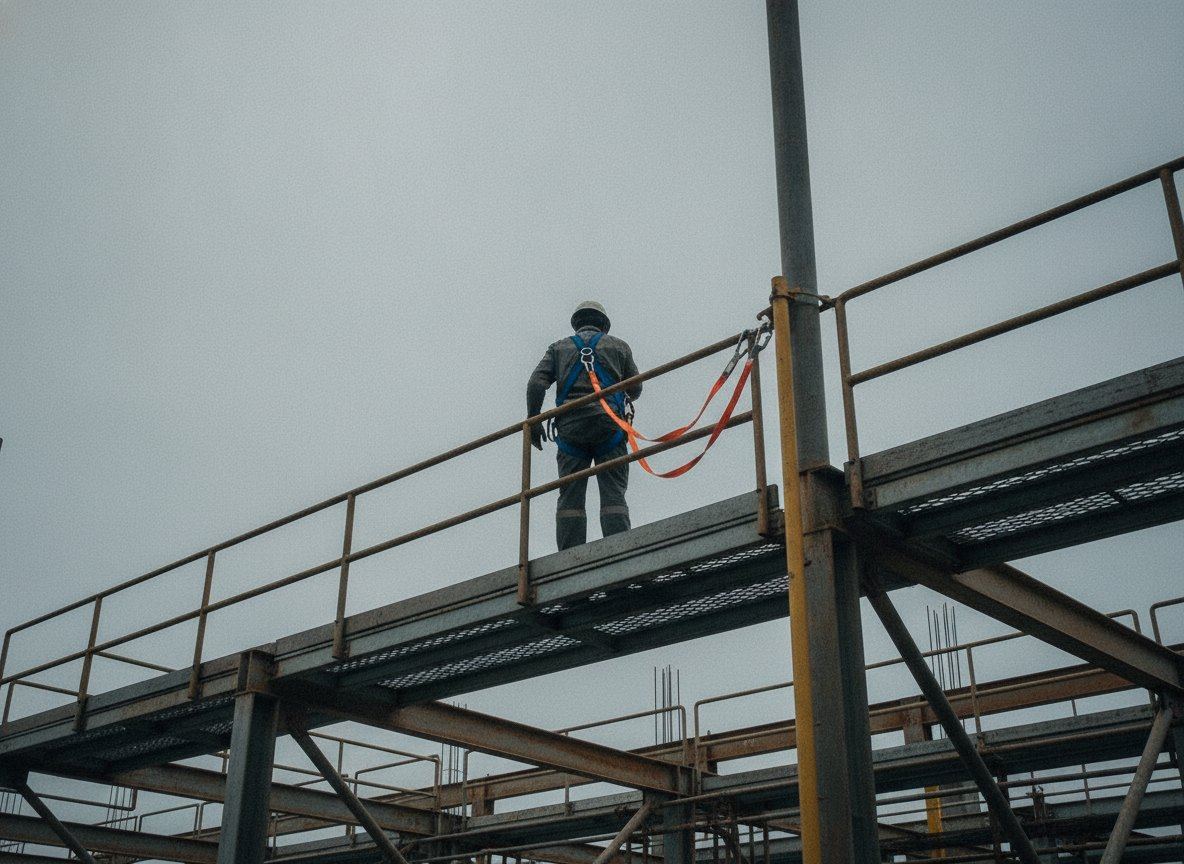
Work at height in Malaysia is governed by the general duties in the Occupational Safety and Health Act 1994.
DOSH's own guideline covers work from two metres up and asks for fall protection at that height. TopBorneo supplies harnesses, lanyards and anchor devices across Malaysia, and inspects them.
The numbers in the guideline
Why work with TopBorneo
Tell us the job, the site and the crew. We work out what fits instead of sending a catalogue back.
MSA, KStrong and Bullard straight from an official distributor, with lighter lines alongside them.
Gas detectors, breathing apparatus and cylinders are serviced by our own technicians.
The same people handle your enquiry, your order and your servicing.
Read more
Open a section to read the detail behind it.
From what height do the rules apply
| Question | The answer, and where it comes from |
|---|---|
| What height | DOSH's Guidelines for the Prevention of Falls at Workplaces 2007 apply to work carried out from two metres or more, and say fall protection shall be supplied and used wherever an employee is at risk of a fall of two metres or more |
| Is that a law | No. The guideline says in its own foreword that it has no force of law. It exists to help employers meet the general duties in the Occupational Safety and Health Act 1994 |
| Which duties | The guideline points to sections 15, 17, 20 and 24 of that Act: the employer's duty to his own workers, to other people, the maker's duty for plant used at work, and the worker's own duty |
| What about the ten feet figure | That figure comes from the Factories and Machinery (Safety, Health and Welfare) Regulations 1970. The Factories and Machinery Act 1967 was repealed on 1 June 2024. Ask your own adviser what still applies rather than copying a number from an old article |
Two metres is the working line that DOSH itself uses. Where a fall could hurt someone, fall protection is expected whatever the tape measure says.
What the guideline asks of the equipment
These are the numbers and rules from the same DOSH guideline, in the order you meet them.
| Item | What the guideline requires |
|---|---|
| Every belt, harness, line and fall arrest device | Regularly inspected and tested against Malaysian Standards or an accepted international standard, and used in line with the maker's instructions |
| Before each use | A careful visual inspection by trained personnel every time the equipment is used |
| The force on the person in a fall | Less than 6 kN. A two metre lanyard with a personal energy absorber, or a type 2 or type 3 fall arrest device, should achieve that |
| Attachment hardware | Designed to withstand a load of 15 kN |
| Fall factor | One at most, which means the fall may not be longer than the lanyard assembly itself |
| Lanyard to a type 1 fall arrest device | Two metres at most, energy absorber included |
| Static line | A minimum breaking strength of 44 kN unless it is an engineered design. A guardrail is never an anchor, because it was not built for the forces of an arrested fall |
| Safety nets | Inspected daily for wear or damage, and rejected if any is found |
kN stands for kilonewton, the unit used for force. One kilonewton is roughly the pull of a hundred kilogram weight, so 15 kN is about one and a half tonnes hanging on one point. That is why a bolt into a thin panel is not attachment hardware.
Roped access work has its own section in the same guideline, with heavier numbers. An anchorage holds a minimum ultimate force of 15 kN in every direction it might be loaded, and 21 kN where the load of two people could reach one anchorage. Lanyards there need a minimum breaking strength of 15 kN. Suspension equipment there is individually identified and checked daily by a competent person, with the records kept.
How often equipment has to be inspected
Malaysia has no single legal interval that covers every harness on every site, so the interval comes from the manufacturer's manual for your model. That manual is not silent, though. EN 365:2004, the European standard behind most fall arrest equipment sold here, says in clause 4.4 b that those instructions have to state a periodic examination frequency of at least every 12 months. Twelve months is the floor the manual has to carry, not a ceiling.
Shorten it when heat, chemicals, abrasion or heavy use are hard on the equipment, and shorten it again if your client's contract says so. Clause 4.6 of the same standard sets out what the record for each item should hold. That is the date and the details of every examination and repair, the name and signature of the person who carried it out, and the date the next one is due.
What stays the same on every site is the pattern: the wearer checks by eye and by hand before every use, and a competent person examines the equipment properly at the interval you keep. See safety harness inspection for how TopBorneo does that and what you get back. For the equipment itself, see fall protection equipment. For who enforces all of this, see the DOSH offices in Sabah, Labuan and Sarawak.
Common questions
What are the working at height requirements in Malaysia?
The duty sits in the Occupational Safety and Health Act 1994. DOSH's Guidelines for the Prevention of Falls at Workplaces 2007 fill in the practice. Fall protection starts at two metres, equipment is inspected before every use, and workers are trained for the method being used. TopBorneo supplies and inspects the personal equipment across Malaysia.
How often should working at height equipment be inspected?
The person using it makes a careful visual check before every single use. On top of that, a competent person examines it at the interval in the manufacturer's manual. Under EN 365 that manual has to name a frequency of at least every 12 months, and hard use shortens it. TopBorneo carries out that periodic examination.
How strong does the anchor hardware have to be?
DOSH's falls guideline says attachment hardware shall be designed to withstand a load of 15 kN. A static line needs a minimum breaking strength of 44 kN unless it is an engineered design. A guardrail is never an anchor. Roped access has its own figures: 15 kN per anchorage, and 21 kN for two people.
What equipment is used when working at height?
The list is a full body harness, a lanyard with an energy absorber or a self retracting lifeline, connectors, and an anchor device or anchor line. Guardrails, work platforms and safety nets come before any of that, because they protect everyone rather than one person. TopBorneo supplies the personal equipment across Malaysia.
Send your equipment list
Email crm@topborneo.com with the maker, model, quantity and date of first use of your harnesses, lanyards and anchor devices. WhatsApp also works: +60 10 959 0259 for Labuan, +60 16 775 0259 for Kota Kinabalu. TopBorneo replies with what can be supplied or inspected, where, and what it costs.