
What one confined space entry needs, from the first gas test to the certificate
One entry from the first gas reading to the inspected harness, with the equipment supplied, rented and serviced by the same team.
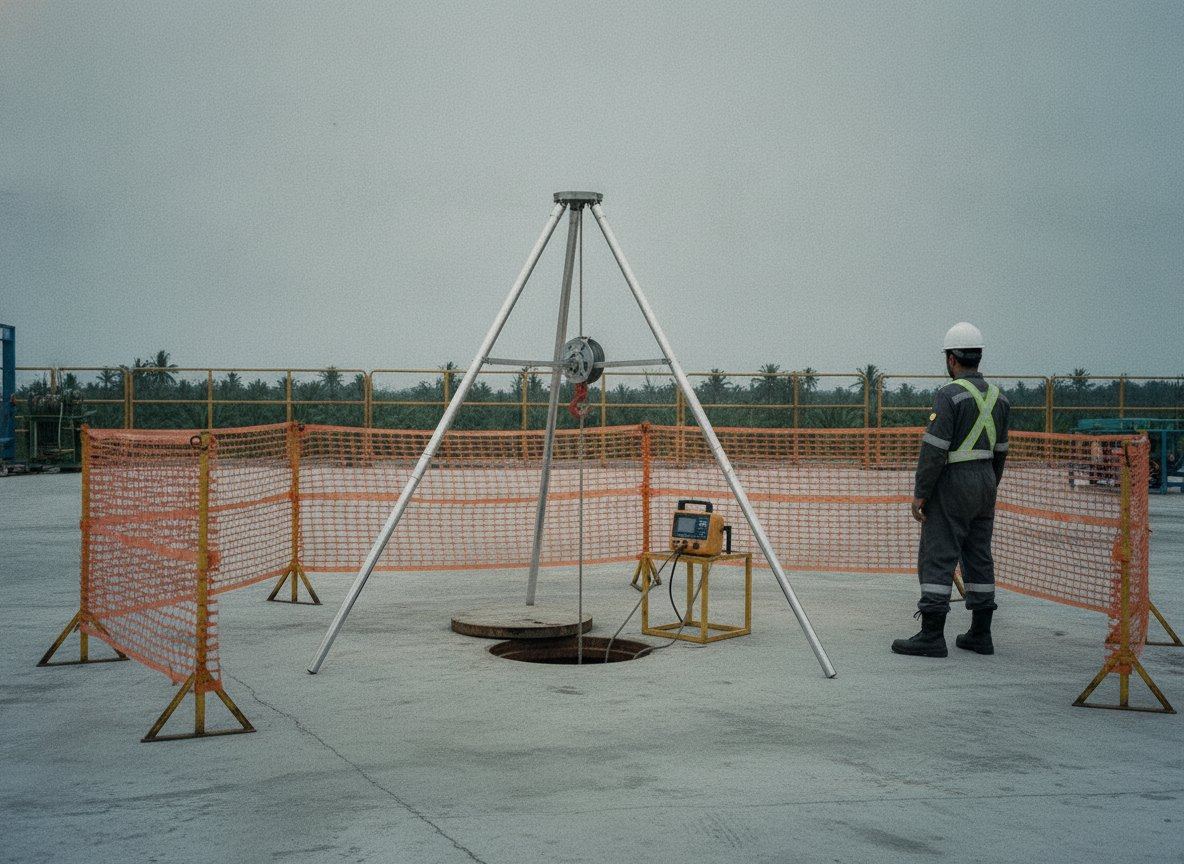
A confined space entry is not one purchase.
It is a morning of work with six or seven pieces of equipment in it, each on its own schedule, and most of the trouble on a job comes from the piece nobody thought about until the crew was standing at the opening. This page walks the entry in the order it happens and says what TopBorneo supplies, what it rents and what it services at every step.
For the range itself, with the types and the alternatives per item, go to confined space equipment. For what the code requires, go to confined space entry requirements.
One entry, from first reading to certificate
Why work with TopBorneo
Tell us the job, the site and the crew. We work out what fits instead of sending a catalogue back.
MSA, KStrong and Bullard straight from an official distributor, with lighter lines alongside them.
Gas detectors, breathing apparatus and cylinders are serviced by our own technicians.
The same people handle your enquiry, your order and your servicing.
Read more
Open a section to read the detail behind it.
The entry, step by step
| Step | What it needs | Where the detail is |
|---|---|---|
| Before anyone approaches | A permit and a gas tester with a current certificate | entry requirements |
| Test the air from outside | Multi-gas detector, sampling pump, hose or probe | gas detection |
| Set up the opening | Tripod or davit, winch, retrieval device, barrier | confined space equipment |
| Clear the air and keep it clear | Blower, ducting | confined space equipment |
| The person going in | Full body harness with rescue attachment points, rescue line | fall protection |
| If the air is not breathable | Breathing apparatus or an escape set | respiratory protection |
| Outside the opening | A stand-by person with the detector reading in view | entry requirements |
| After the job | Certificate for the detector, inspection of the tripod, winch and harnesses | fall protection inspection |
The gas test is the step with the deadline on it
The detector is the only item in the list that can be technically fine and still stop the job. It has to be inside its calibration interval on the morning of the entry, and the certificate has to be there to show it. MSA recommends a bump test before each day's use and calibration at a maximum interval of six months.
That means the last useful moment to think about the detector is not the week of the job. If the certificate runs out during the entry window, the unit goes out for portable gas detector calibration first. A detector can also be rented for the job, and a rented one arrives calibrated. See gas detector rental.
Two things on the same job with different inspection schedules
The tripod and the winch are lifting equipment. The harness and the rescue line are fall protection. They go into the same opening on the same morning and they are inspected on different schedules, which is why they are easy to get out of step with each other.
TopBorneo inspects both and writes the outcome down per item, so one list comes back covering the whole set rather than two lists from two places. Send the item numbers with the make, the model and the date of first use.
When the whole set is rented instead of bought
A crew that enters a tank twice a year gets more out of renting the tripod, the winch and the detector than out of owning them, because the equipment sits idle between jobs and the inspection and calibration run whether it is used or not. A rented set arrives ready and goes back when the job ends. See confined space equipment rental.
Buying makes more sense once the entries are frequent enough that a set is in use most months. The harnesses are usually bought either way, because they are fitted to people.
There is a level for every budget
The official lines are MSA, KStrong and Bullard, and next to them TopBorneo carries lighter and cheaper lines for the same work. A crew that enters a tank twice a year does not need the same tripod as a crew that does it weekly. Say what the work is and the quotation comes back with the levels next to each other.
Common questions
What equipment is needed for a confined space entry in Malaysia?
A multi-gas detector with a sampling pump for the test from outside, a tripod or davit with a winch over the opening, a full body harness with rescue attachment points and a rescue line, a blower with ducting if the air has to be cleared, and breathing apparatus or an escape set where the atmosphere is not breathable. Malaysia's Industry Code of Practice for Safe Working in a Confined Space 2010 also requires an Authorised Gas Tester and Entry Supervisor, or AGTES, with a detector that is in calibration.
Can the whole entry set come from one supplier?
Yes. TopBorneo quotes the detector, the tripod, the winch, the harnesses and the blower on one quotation, so the job goes on one purchase order instead of four.
How long before the job should the detector be sent for calibration?
Send the model and the serial number and TopBorneo comes back with what the unit needs and how long that takes. If the timing is tight, renting a detector for the job is the faster route, because a rented unit arrives calibrated.
Who is allowed to take the gas reading?
An Authorised Gas Tester and Entry Supervisor, AGTES, under Malaysia's Industry Code of Practice for Safe Working in a Confined Space 2010. The detail is on the confined space entry requirements page. TopBorneo supplies and calibrates the detector that person uses.
Send the job
Email crm@topborneo.com with what the space is, how many entries and when the work starts, or send it to the Labuan or Kota Kinabalu WhatsApp number. A description is enough to quote against. If you already have equipment, the make, model and serial number of the detector and the item numbers of the harnesses get the inspection side moving at the same time.