
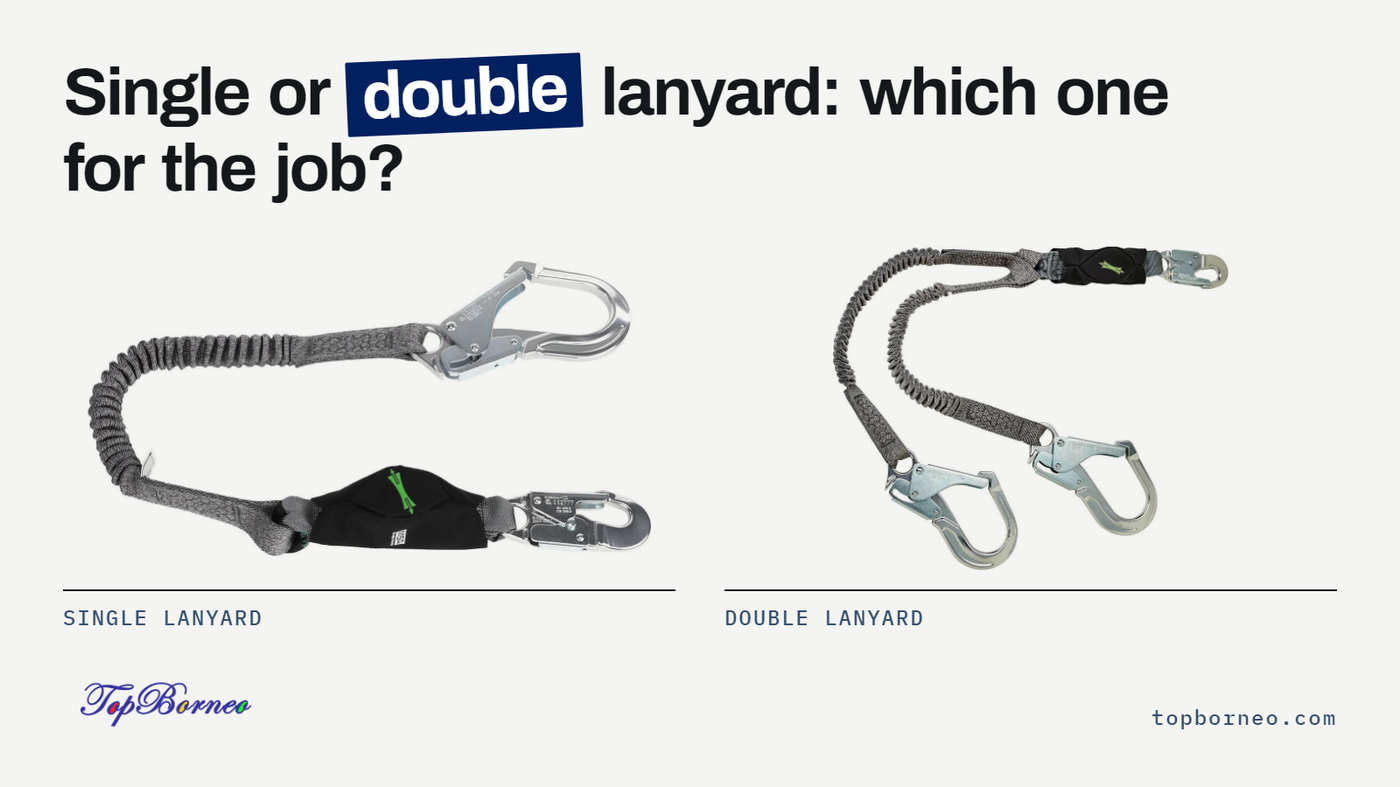
Pick the lanyard by how the job moves. A worker on a tower who reaches for the next anchor point with a single lanyard has to unclip first, and until the new clip is made the worker is attached to nothing. A double lanyard closes that gap, because one leg stays attached while the other changes places.
| The job | The lanyard | Why |
|---|---|---|
| The worker stays at one spot, with one anchor point in reach | Single lanyard with an energy absorber | Nothing needs unclipping while the worker stays put |
| The worker moves along a tower or a structure and changes anchor points | Double lanyard with an energy absorber | One leg stays on an anchor point while the other moves to the next |
TopBorneo, an official distributor of MSA and KStrong, quotes the lanyard with the harness. See fall protection. Send the number of people, the kind of work and whether they move between anchor points to sales (at) topborneo.com, or use WhatsApp.
For a twin lanyard, MSA's user instructions for its lanyards, US edition, order no. 10188906, give the rule in two sentences.
Maintain tie-off while moving between anchorage locations. Do not disconnect from your initial position until you have first connected to another anchorage.
A second leg keeps the worker attached, and adds ways to get it wrong
MSA describes twin lanyards as allowing continuous tie-off between anchorage locations, and says lanyards with an integral energy absorber "are designed to dissipate force in a fall".
The mistakes are in how the legs are connected. In MSA's US instructions, the middle snaphook, where the two legs meet, goes on the back D-ring of the harness, and the two leg ends go on approved anchor points. A leg that is not in use goes only on the lanyard keeper of the harness, not on a side or front D-ring. The legs must not pass under the arms, between the legs or round the neck.
MSA also warns against connecting a leg end to the user's own "body support", because that can increase the possible free fall distance beyond allowable limits.
Either type needs clear space below the worker for a fall. The maker's instructions say how much.
A lanyard that has stopped a fall leaves service, and the rest are examined on a schedule
A lanyard that has stopped a fall leaves service at once: MSA says to tag it unusable and dispose of it, and the UK Health and Safety Executive (HSE) says it should never be reused.
Every other lanyard is examined by a competent person who is not the user, at set intervals. That person also decides how heavy the use of the lanyard is. UK HSE notes that the standard BS EN 365:2004 says components should be examined at least every 12 months. MSA gives the examination interval for its own lanyards by use.
| Use | MSA interval |
|---|---|
| Infrequent to light | Every 12 months |
| Moderate to heavy | Every 6 to 12 months |
| Severe to continuous | Every 3 to 6 months |
UK HSE recommends a detailed inspection at least every 6 months, and MSA's pre-use steps ask whether a formal inspection took place in the last 6 months. TopBorneo inspects lanyards, harnesses and fall arrest blocks, and the outcome comes back on paper for each item. See safety harness and fall arrest inspection for what an inspection covers and how the interval is set. For lanyards you already have, send the maker, model, quantity and date of first use. TopBorneo replies with what each of those lanyards needs.
Between examinations, the lanyard gets a check before every use. The falls guideline of the Department of Occupational Safety and Health (DOSH) asks for a careful visual check by trained personnel each time. UK HSE, in its leaflet INDG367, adds that the check is done with the hands as well as with the eyes. Pass the whole lanyard slowly through the hands to feel for softening, hard patches and dirt, and for cuts of 1 mm at the edges. UK HSE says such a cut in a webbing lanyard can already take a large share of its strength.
Related reading
- Fall protection
- Safety harness and fall arrest inspection
- Working at height requirements in Malaysia
- Construction safety equipment
- Safety helmet colour by job, and when to replace: another item that leaves service after one bad event.